India’s hosiery industry is one of the largest in the world, and its fabric manufacturing ecosystem is the engine that powers everything from everyday cotton briefs to premium modal lingerie. If you are a garment brand, an innerwear label, a private-label buyer, or an international sourcing manager, finding the right hosiery fabric manufacturer in India can determine your product’s comfort, cost efficiency, and consistency.
This guide explains everything B2B buyers need to know; the types of hosiery fabric available, what quality benchmarks matter, why Tirupur dominates hosiery fabric supply, and how to evaluate a manufacturer before placing your first bulk order.
What Is Hosiery Fabric?
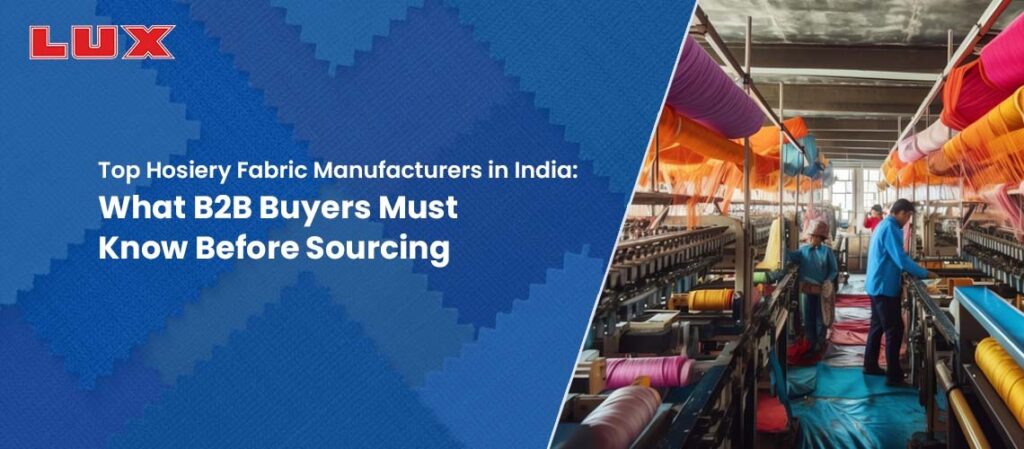
Hosiery fabric refers to knitted textiles produced on circular or flat-bed knitting machines, primarily used in the production of innerwear, undergarments, casual apparel, and legwear. Unlike woven fabrics, hosiery fabrics have inherent stretch and recovery properties, making them the natural choice for body-hugging garments like briefs, vests, T-shirts, leggings, and lingerie.
The term “hosiery” in the Indian textile context broadly encompasses all knitted fabric and garments, with Tirupur in Tamil Nadu at the absolute centre of this industry.
Types of Hosiery Fabric B2B Buyers Should Know
Understanding the fabric constructions available helps you specify exactly what your production requires.
Single Jersey: The most commonly used hosiery fabric globally. Lightweight, soft, and cost-effective, it is the workhorse of men’s vests, ladies’ inner tops, and kids’ innerwear. Available in 100% cotton, cotton-spandex, viscose, and polyester variants.
Rib Fabric: (1×1, 2×1, 2×2) Has a pronounced vertical line and higher elasticity than single jersey. Used for waistbands, cuffs, V-neck bodies, and full-body innerwear that requires a snug fit with comfortable stretch.
Interlock: A double-sided, smoother knit with excellent dimensional stability. Preferred for premium innerwear, ladies’ camisoles, and thermal undergarments where fabric pilling and surface sheen matter.
Cotton-Spandex: Lycra) Jersey, the dominant fabric for stretch innerwear; mens trunks, ladies’ panties, sports briefs, and athletic underwear. The spandex content (typically 5–8%) adds stretch, recovery, and shape retention.
Modal & Viscose Fabric: Derived from natural wood pulp fibres, modal fabrics are exceptionally soft, breathable, and drape beautifully. Used in premium and mid-premium innerwear and lingerie lines.
Fleece & Terry Fabric: Used in thermal innerwear and casual innerwear layers for colder markets. Gaining popularity among winter-season manufacturers in North India.
Why Tirupur Is India’s Hosiery Fabric Capital
When B2B buyers worldwide ask about hosiery fabric manufacturers in India, every supply chain expert points to one place that is Tirupur, Tamil Nadu.
Tirupur accounts for over 90% of India’s hosiery exports, contributing approximately ₹30,000 crore in annual exports. The city’s competitive advantage is structural; it was built over decades and cannot be replicated overnight:
Clustered supply chain: Yarn spinners, fabric knitters, dye houses, finishing units, elastic manufacturers, label printers, and carton suppliers all exist within a 30-kilometre radius. This cluster effect reduces lead times, logistics costs, and sourcing complexity for B2B buyers dramatically.
Skilled workforce: Tirupur has generations of workers and technicians who specialise in hosiery. Skills in fine-gauge knitting, reactive dyeing, and garment assembly are deeply embedded in the local labour market.
Export infrastructure: Tirupur has direct container logistics to Chennai Port and Coimbatore International Airport, with established freight forwarders and customs agents who specialise in hosiery exports.
Innovation in blends and constructions: The concentration of manufacturers in Tirupur creates intense competition for B2B business, which drives continuous improvement in fabric quality, new blend development, and finishing technology.
Key Quality Parameters When Sourcing Hosiery Fabric in India
Not all hosiery fabric is equal. B2B buyers who source without specifying quality parameters risk receiving inconsistent lots that will disrupt their production lines. Here are the critical parameters to agree on with any hosiery fabric manufacturer in India before placing an order:
GSM (Grams per Square Metre): GSM determines the fabric’s weight, hand feel, and end-use suitability. Innerwear typically uses fabrics in the 120–200 GSM range. Specify your target GSM and acceptable tolerance (±5 GSM is standard).
Yarn Count and Type: The fineness of yarn (higher count = finer yarn) directly affects fabric softness and cost. Specify whether you require combed, super-combed, or carded cotton, and whether Pima or Supima cotton is needed for premium lines.
Spandex Content: For stretch fabrics, spandex percentage (usually 5–8% for innerwear) must be clearly specified. Variations in spandex content change stretch, recovery, and print behaviour significantly.
Shrinkage: Acceptable shrinkage after washing is typically ≤5% in both warp and weft. Insist on wash test reports for all new fabric developments.
Colour Fastness: For dyed fabrics, international ratings (AATCC/ISO) for washing, rubbing, and light fastness must be specified especially for export to markets with strict import quality standards.
Bursting Strength: Particularly important for performance and athletic innerwear. A minimum bursting strength threshold prevents fabric failure at stress points in garments.
What to Look for in a B2B Hosiery Fabric Manufacturer in India
Beyond fabric specifications, the manufacturer you choose determines your supply reliability, cost trajectory, and quality consistency over time. Evaluate potential partners on:
Vertical Integration: Manufacturers who control their own yarn sourcing, knitting, dyeing, and finishing are better positioned to maintain consistent quality and respond faster to modifications. Avoid pure trading houses that outsource production across multiple vendors.
Production Scale: A manufacturer’s daily output capacity tells you whether they can reliably absorb your order volumes including during seasonal peaks. Partnering with manufacturers who produce at scale means you are rarely deprioritised during busy periods.
Quality Certifications: ISO 9001:2015 certification is the baseline. For export-oriented sourcing, also look for OEKO-TEX Standard 100, GOTS (for organic cotton), and BCI (Better Cotton Initiative) certifications depending on your end-market requirements.
B2B Track Record: Ask for client references in your category; brands or manufacturers who have been sourcing the same fabric type from them for more than two to three seasons. Consistent repeat business is the best proxy for reliable supply.
Testing Facilities: In-house testing laboratories that can issue reports on GSM, shrinkage, colour fastness, and breaking strength are a significant advantage. It shortens quality loops and reduces dependence on third-party labs.
Minimum Order Quantities: Understand the manufacturer’s MOQ structure clearly before engaging. Some manufacturers set fabric MOQs at 500–1,000 kg per colour, while vertically integrated manufacturers with larger operations may offer smaller initial lots for trial orders.
The B2B Advantage of Working with a Vertically Integrated Manufacturer
India’s hosiery fabric supply chain includes a mix of standalone fabric mills, integrated garment manufacturers, trading houses, and brand manufacturers who also run B2B fabric supply arms.
The strongest B2B proposition and the best value for buyers lies in working with vertically integrated manufacturers who control the entire chain from yarn to finished product. This is particularly true for companies like Lux Industries Limited, where the same infrastructure that powers India’s most recognised innerwear brands also serve B2B clients.
The benefits are concrete:
Consistency: When yarn sourcing, knitting, and dyeing happen under one quality system, batch-to-batch consistency is dramatically higher than supply chains assembled from multiple vendors.
Speed: Integrated manufacturers can turn around development samples, counter-samples, and production lots faster because there are no inter-party handoffs and communication gaps.
Cost Transparency: Buyers dealing directly with an integrated manufacturer avoid the margin layers added by trading intermediaries.
Accountability: A single manufacturer is responsible for everything. There is no scope for finger-pointing across multiple vendors when quality issues arise.
India’s Hosiery Fabric Industry – Market Context for B2B Buyers
India is currently the world’s third-largest cotton producer and one of the top global exporters of hosiery garments. The domestic innerwear market alone is estimated at over ₹40,000 crore and growing at 10–12% annually, driven by rising disposable incomes, urban penetration of branded innerwear, and a rapidly expanding women’s innerwear category.
For B2B fabric buyers, this means:
Demand for premium cotton, modal, and cotton-spandex fabrics is growing and Indian manufacturers are investing heavily in machinery and process upgrades to serve this demand.
Export demand from Middle Eastern, African, and European markets for Indian hosiery garments remains robust, making B2B fabric supply a strategically important segment for any large hosiery manufacturer.
Private-label and white-label innerwear is a rapidly expanding category as Indian and global brands look to launch affordable, quality innerwear lines without building their own manufacturing infrastructure.
Partnering with Lux Industries for B2B Hosiery Fabric
Lux Industries Limited brings together everything a serious B2B buyer needs: six decades of manufacturing heritage, a production capacity of over one lakh garments per day, ISO 9001:2015 certification, in-house testing, and a vertically integrated supply chain rooted in Tirupur.
Whether you need cotton hosiery fabric for men’s vests and briefs, cotton-spandex for ladies’ panties and trunks, or modal blends for premium lingerie lines, our B2B team works with you to develop the exact specifications your production requires.
We supply to innerwear brands, garment exporters, private-label manufacturers, and distributors across India and 25+ countries with the scale, consistency, and accountability that serious B2B relationships demand. Ready to source hosiery fabric from India’s most trusted manufacturer? Visit our B2B hosiery fabric manufacturer page or contact our B2B team directly at info@luxglobal.co.in