
The women’s innerwear market in India is undergoing a remarkable transformation. What was once a category dominated by unbranded economy products sold through local stores is now one of the fastest-growing segments of India’s apparel industry with organised brands, premium fabrics, and a consumer base that is more informed and demanding than ever before.
For garment brands, private-label retailers, and export-oriented buyers, this shift creates a significant B2B sourcing opportunity. But finding the right ladies innerwear manufacturer in India; one who can deliver consistent quality, meet the range requirements of a modern women’s innerwear line, and grow with your brand requires a clear-eyed sourcing strategy.
This guide walks you through everything you need to know about sourcing ladies’ innerwear in India: the key manufacturing hubs, product categories, fabric considerations, and how to evaluate manufacturers before committing your production.
The Indian Women’s Innerwear Market: Context for B2B Buyers
India’s women’s innerwear market is estimated at over ₹18,000 crore and is projected to grow at 12–15% annually over the next five years. The growth drivers are structural and durable:
- Rising female workforce participation is driving demand for comfortable, functional everyday innerwear that can be worn for extended periods.
- E-commerce penetration has democratised access to branded women’s innerwear across Tier 2 and Tier 3 cities, creating demand for both economy and premium products from areas previously dominated by unbranded goods.
- Fabric awareness among urban consumers has grown significantly, with modal, microfibre, and seamless construction gaining acceptance among mid-income buyers.
- International brand entry has raised quality benchmarks, creating an opening for Indian manufacturers who can match global quality at competitive prices.
For B2B buyers whether domestic brands or international sourcing teams, the question is not whether to source from India, but how to find the right manufacturing partner within India’s complex and varied hosiery ecosystem.
Where Are Ladies Innerwear Manufacturers Concentrated in India?
India has several garment manufacturing clusters, but for ladies’ innerwear specifically, the overwhelming concentration is in Tirupur, Tamil Nadu, with secondary activity in surrounding areas like Coimbatore, Erode, and Chennai.
Tirupur handles the bulk of India’s women’s innerwear manufacturing and export because:
The city’s decades of knitting and hosiery expertise translate directly into the fine-gauge fabric construction that women’s innerwear demands. Ladies’ panties, camisoles, bralettes, and inner tops require finer yarn counts, better stitch consistency, and tighter quality control than basic men’s vests capabilities that are deeply embedded in Tirupur’s manufacturing base.
Tirupur manufacturers have continuous innovation in cotton-spandex fabrics, lace trim application, seamless knitting, and fine-gauge modal construction; all of which are central to a competitive ladies’ innerwear range.
The city’s export orientation means Tirupur ladies innerwear manufacturers are familiar with compliance requirements for international markets, a significant advantage for buyers sourcing for export.
Other manufacturing clusters like Ludhiana (Punjab) produce thermal innerwear, while Delhi and Mumbai have cutting and stitching units, but for volume, fabric quality, and range completeness, Tirupur is unmatched for ladies’ hosiery innerwear.
Categories of Ladies Innerwear You Can Source from India
India’s hosiery manufacturers, particularly those in Tirupur can produce the full spectrum of women’s innerwear:
Panties and Briefs
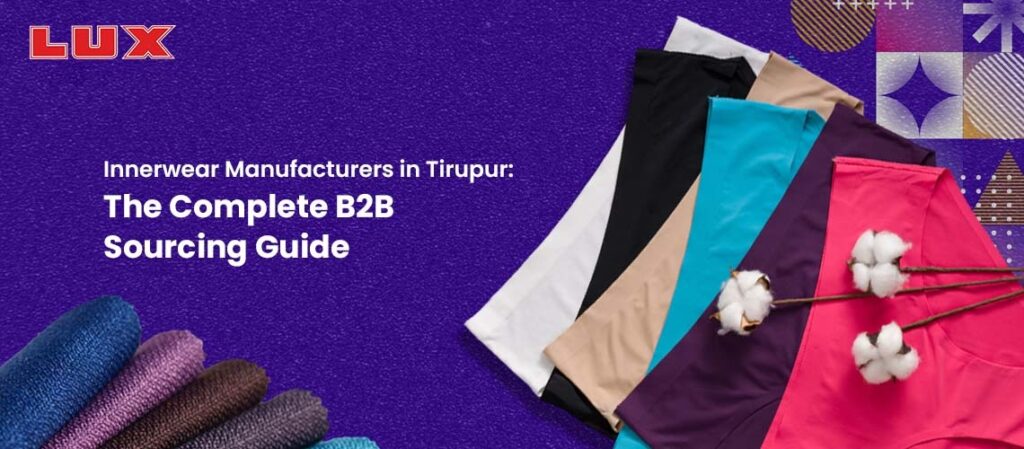
The highest-volume category. Available in hipster, boy short, bikini, brief, thong, and high-waist cuts. Fabric options include 100% cotton, cotton-spandex, microfibre, modal, and lace-trim cotton. Quality range spans economy (OE cotton) to premium (super-combed 60s/80s combed cotton with spandex).
Camisoles and Inner Tops
Sleeveless inner tops are a large-volume category in the Indian women’s innerwear market. Available in rib and single jersey constructions with adjusted necklines, lace trims, and embroidered details for premium segments.
Bralettes
The fastest-growing subcategory as consumers moves away from traditional underwired bras for casual/lounge wear. Manufactured in cotton-spandex, microfibre, and modal with seamless options available from advanced manufacturers.
Slips and Full Slips
Widely used in Indian markets for layering under salwar suits, sarees, and dresses. Lightweight single jersey and satin-finish modal fabrics are used.
Shapewear
A growing category, particularly for export markets. High-spandex content fabrics with graduated compression are used. Requires specialised flat-bed and circular knitting equipment.
Kids’ Girls’ Innerwear
Bloomers, slips, and briefs for girls, a significant volume category for manufacturers supplying wholesale distributors and multi-brand retail chains.
Fabric Matters: What Drives Quality in Ladies Innerwear
More than in any other garment category, fabric quality directly defines the consumer experience in ladies’ innerwear. As a B2B buyer, insisting on the right fabric specifications is the most important lever you have over product quality.
Cotton Quality: Count and Combing
The fineness of cotton yarn (measured in counts – 30s, 40s, 60s, 80s) and whether the cotton is carded, combed, or super-combed determines the fabric’s softness, smoothness, and pilling resistance. Ladies’ innerwear that claims a premium positioning should use 40s or higher combed cotton or super-combed cotton. Economy products use OE (open-end) spun yarn in the 20s–30s range.
Spandex Content and Recovery
For stretch innerwear; panties, bralettes, leggings – spandex content and quality are critical. Higher quality spandex (from premium suppliers like Lycra brand) delivers better snap-back recovery and retains stretch properties through repeated washing.
Modal and Viscose
Modal fabric derived from beech wood pulp offers exceptional softness and moisture management. For premium and mid-premium ladies’ innerwear lines competing against international brands, modal is often a key fabric differentiator. Ensure your manufacturer uses certified modal fabric rather than lower-grade viscose substitutes.
GSM Consistency
Ladies’ innerwear fabric GSM consistency is critical for cut-and-sew operations. Variations in GSM affect lay planning, cutter efficiency, and final garment weight; all of which compound into cost and quality issues at scale.
Colour Fastness and Washing Durability
Ladies’ innerwear customers expect that panties and camisoles hold their colour through repeated washing without staining other garments. Insist on reactive dyeing (for cotton) with verified wash and rubbing fastness ratings before approving bulk production.
Evaluating Ladies Innerwear Manufacturers in India: A B2B Checklist
Use this checklist when evaluating potential manufacturing partners for ladies’ innerwear in India:
Product Category Coverage: Does the manufacturer have active production experience in the specific categories you need; panties, bralettes, camisoles, shapewear? Not all innerwear manufacturers have equal expertise across all subcategories.
Fine-Gauge Fabric Capability: Ladies innerwear requires finer fabric constructions (60s–80s combed cotton, fine-denier spandex) than men’s innerwear. Confirm the manufacturer has the right knitting equipment and yarn sourcing relationships for fine-gauge production.
Trim and Embellishment Experience: If your line requires lace trims, embroidery, printed waistbands, or decorative elastic, confirm the manufacturer has in-house capability or established subcontractors for these elements.
Fit Grading and Pattern Development: Ladies innerwear sizing is more complex than men’s. Evaluate the manufacturer’s pattern grading capability across your required size range (typically XS to 3XL for Indian market, or XS–2XL for export markets).
Minimum Order Quantities: Ladies innerwear typically has higher style and size variety than men’s; your MOQ per style/size combination needs to be practical for your range width.
Women’s Sample Development: Ask for recent development samples and evaluate stitching quality, seam alignment, label placement, and fabric hand. Ladies’ innerwear samples reveal construction quality faster than any factory audit.
Compliance for Export: For international retail, confirm OEKO-TEX Standard 100 compliance for all fabrics used. EU and UK markets are increasingly strict about chemical compliance in intimate apparel.
The Private-Label Opportunity in Ladies Innerwear
One of the most significant trends among Indian and international brands is the growth of private-label ladies innerwear, branded products manufactured by established hosiery manufacturers but sold under the buyer’s own brand identity.
For brands entering the innerwear category without wanting to build their own manufacturing infrastructure, private-label manufacturing offers:
The fabric quality, manufacturing expertise, and quality systems of an established manufacturer without the capital investment in plant and machinery.
Access to a manufacturer’s existing fabric range as a starting point, with customisation available for brand-specific colours, trims, and constructions.
Speed to market, established manufacturers can launch a private-label ladies innerwear range in 90–120 days from initial brief to first delivery for well-defined product specifications.
Manufacturers like Lux Industries, with decades of innerwear brand-building experience, are ideal private-label partners precisely because they understand what makes innerwear brands succeed at retail not just how to manufacture the product.
Why Lux Industries Is a Preferred B2B Partner for Ladies Innerwear
Lux Industries has built some of India’s most successful women’s innerwear brands; Lux Amore and Lux Karishma from the ground up. The product development, fabric sourcing, quality standards, and construction expertise behind these brands are available to our B2B and private-label clients.
Our ladies’ innerwear manufacturing capabilities cover panties, hipsters, camisoles, inner tops, slips, and girls’ innerwear across cotton, cotton-spandex, and modal fabrics. Custom development, private-label production, and white-label manufacturing are all available for qualified B2B partners.
With ISO 9001:2015 certification, in-house quality testing, and over six decades of Tirupur manufacturing expertise, Lux Industries offers ladies innerwear B2B buyers the combination of quality assurance and supply reliability that established brands require.
Contact our B2B team to discuss your ladies’ innerwear sourcing requirements: info@luxglobal.co.in or explore our B2B hosiery fabric manufacturer page.